| Plant Profile: |
|
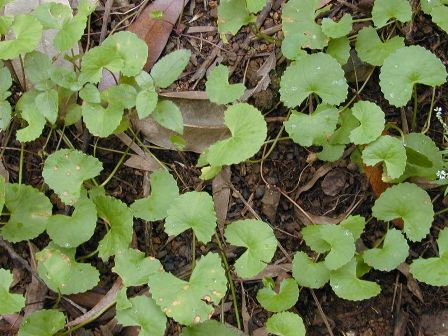
The plant trails on the ground and its creeping stem bears roots at the nodes. The leaves are long stalked, round to kidney shaped, cordately based and deeply toothed margins. The flowers are minute, pinkish or red and in clusters of three to six flowers. The fruit is small like a grain of barley with 7-9 ridges. The plant grows in moist places throughout India. It is commonly seen in the marshy banks of rivers, streams, ponds and in irrigated lawns and fields particularly in lower parts of Himachal Pradesh and Uttaranchal. Flowering takes place in July and fruiting in September. People usually collect leaves and stems from the wild during September-November.
|
| Medicinal uses: |
| Parts used: Herbage mostly leaves (fresh and dried leaves). |
| Active principles: It contains a bitter substance, a glucoside, asiaticoside, essential and fatty oils, sitosterol, tannin and resinous substance besides the alkaloid hydrocotylin. A bitter principle vallarine, pectic acid and resin are present in the leaves and roots of the plant. The plant also contains ascorbic acid in a concentration of 13.8 mg per 100 g. A mixture of brahmoside and brahminoside glycosides from the plants increases the hexabarbitone-induced sleeping time. |
Disease cured and dosage:
- Ethnomedicinal: The leaves or entire plant parts are boiled in water and this decoction is given in the treatment of leprosy. The glucoside asiaticoside is considered responsible for its use in leprosy. The plant is also considered useful in epilepsy and is tonic for brain. It is a reputed tonic for fatigue after mental work and is specially used for loss of memory. Vaids in Joshimath used it as a nervine tonic and in psychosomatic disorders.
- Ethnoveterinary: Data not sufficient
|
| Ayurveda/Unani prepration: Brahmi-panak, brahmi-taila, saraswatarishta, saraswat-ghrita, brahmi-swaras and brahmi-vati. |
Ayurvedic properties and actions:
- Guna (Qualities): Laghu (light)
- Rasa (taste): Tikta (bitter)
- Vipaka (post digestive taste): Madhur (sweet)
- Virya (potency): Sheet (cold)
- Prabhav (effects): Medhya (intellect promoting)
As per Charaka Samhita it is considered as prajasthapana (fertility promoters) and vayasthapana (longevity promoters).
|
Therapeutic description:
- Effect on humours: Alleviates pitta and kapha.
- Systemic effects: Used to treat leprosy, wounds and other skin diseases.
- Nervous system: It is used to treat nervine debility, epilepsy, hysteria and schizophrenia. It is regarded as one of the best psychotropic drugs.
- Blood vascular system: Cures cardiac debility and other inflammatory disorders.
- Respiratory system: Treats productive cough, hoarseness of voice and dyspnoea.
- Digestive system: It is used in the treatment of dyspepsia, IBS (irritable bowel syndrome) and other digestive upsets.
- Urino-genital system: Treats diabetes insipidus and puerperal lactogenic disorders.
- Skin: Cures leprosy, scrophulla, tubercular ulcer, filariasis and second stage of syphillis.
|
Drug preparation: To convert the plant into a drug, the leaves are washed, dried and powdered. The powder is dissolved in water to prepare a solution.
- The name of the drug is brahmi-churna or brahmi-taila.
- It is stored in moisture and damp free containers.
- The shelf life of the drug is one year.
- It is externally applied in the form of oil or soft paste. It can be taken internally by direct ingestion or chewing.
|
|
|
 |
|
| Family:
Apiaceae |
| Common name:
Brahmi, Mandukparni |
| Local name: Bhonga-nagpo (Lahaul), Budhbrahmi Brahmi (Joshimath), Bengsang, Brahmi (Hindi) |
| Ayurvedic name:
Mandukparni, Manduki, Brahmi, Saraswati |
|
|
|
| File Size:543.232421875kb |
|
|




