| Plant Profile: |
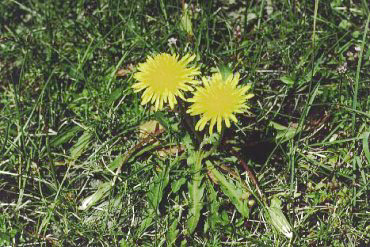
| Taraxacum officinale has shiny-toothed leaves, which give the plant its common name of dandelion (an adaptation of the French ‘dent de lion’ or lion’s tooth). The plant is a small erect perennial herb 5-20 cm tall with milky latex. The rhizome is thick, vertical, almost passing into a taproot, 12-15 cm long, nearly cylindrical, fleshy and crowned with several short remains of leaves, with numerous rootlet scars. The leaves are radical, sessile, arranged in a basal rosette, variable, usually glabrous, narrowly oblong, 5-20 cm long. The florets are golden-yellow achenes, which are glabrous, flattened, spindle-shaped, crowned with soft, white, copious pappus of white hairs and are borne solitary on hollow, leafless peduncles. This herb is found throughout the temperate Himalaya at an altitude range between 3000-5500 m almost everywhere as weeds in fields, road sides, grass lands, wastelands, grassy meadows, moist and shaded places. Flowering occurs in June and fruiting in August. It is harvested in autumn in the month of September-November when the aerial part is almost dried up. |
| Medicinal uses: |
| Parts used: The roots, flowering stems, leaves, flower heads and rhizomes. |
Active principles: Taraxacum is reported to contain resin, essential oil, pectose, enzyme, fatty acids including mellisic and p-hydroxyphenylaceticacids, sitoserol, stigmasterol saponin, taraxasterol, homotaraxasterol, inulin, levulin, sugar and wax.
|
Disease cured and dosage:
- Ethnomedicinal: In Lahaul valley, fresh leaves are used as bandages on cuts and injuries. In Spiti, 2 g of the powdered capitula is given thrice a day to cure headache and fever. It is commonly regarded as being slightly tonic, blood purifier aperient and diuretic. It appears to have an almost specific action on the liver and kidney. On the liver it acts by modifying and increasing its secretion. Hence it is extensively employed in chronic diseases of the digestive organs, especially hepatic affections like jaundice, chronic inflammation or enlargement of liver, dropsy from hepatic obstruction and dyspepsia with deficient biliary secretion. The herb is shown to have shown slight antibiotic activity against Mycobacterium tuberculosis.
- Ethnoveterinary: Data not sufficient
|
| Ayurveda/Unani prepration: Payaswini churna, Payaswini kwath. Prescribed dose - churna ½-1 g, kwath 25-50 ml. |
Ayurvedic properties and actions:
- Guna (Qualities): Laghu (light), ruksha (dry), tikshna (sharp)
- Rasa (taste): Tikta (bitter), Katu (pungent)
- Vipaka (post digestive taste): Katu (pungent)
- Virya (potency): Ushna (hot)
|
Therapeutic description:
- Effect on humours: Alleviates pitta, kapha.
- Systemic effects: Treats wounds (cleaning with its decoction).
- Digestive system: Used to treat dyspepsia, digestive upsets, flatulence, constipation, jaundice, hepatomegaly and worms-infestation.
- Blood vascular system: Cures certain inflammatory disorders.
- Urino-genital system: Used to treat dysurea and incontinence of urine.
|
Drug preparation: To convert the plant into a drug, the parts are dried under sun and ground into a fine powder.
- It is stored very carefully in moisture free containers to avoid its decay by maggots.
- The powder has a shelf life of 6 months to a year.
- It can be externally applied as a poultice, bandage or decoction for wound cleaning.
|
|
|
 |
|
| Family:
Asteraceae |
| Common name:
Dudhi, Common dandelion |
| Local name: Sia-mentok, Quanti (Lahaul), Sarkhen, Mendok (Spiti), Rasuke (Ladakh), Dudhli (Hindi) |
| Ayurvedic name:
Dugdhapheni, Payaswini |
|
|
|
| File Size:148.8349609375kb |
|
|




