| Plant Profile: |
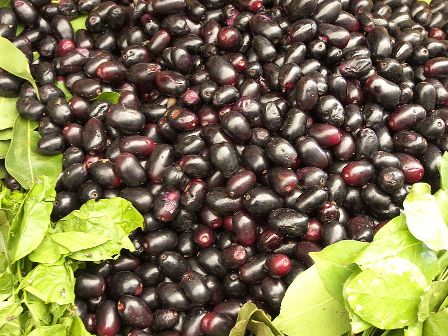
| It is a tall tree growing up to a height of 100 feet and width of 12 feet. The leaves are 3-6 inches long, 2-3 inches wide and very shiny. The flowers are greenish white in colour. It is a common tree in India and found to 1500 m. Flowering occurs in April-June and fruiting in June-July. |
| Medicinal uses: |
| Parts used: Fruit, fruit-bone, bark and leaves. |
Active principles: The fruit contains 83.7% humidity, 14% carbohydrate, 0.7% protein and 0.3% fat. It also contains Vitamin A, B, C, melic acid and oxalic acid. The seeds contain calcium, protein, 19% tenin, ilegic acid, gallic acid, jamboline, starch and 0.05% aromatic oil. The bark contains betulinic acid, ? sitosterol, fridelin, tenin, and miricetin.
|
Disease cured and dosage:
- Ethnomedicinal: It is used in kapha and pitta ailments. A powder of the bark is used to treat bleeding, gonorrhoea, syphilis, pyrexia, IBS, gastrointestinal disorders and diabetes. The fresh leaves are used as an emetic agent.
- Ethnoveterinary: Data not sufficient
|
| Ayurveda/Unani prepration: Ambhvad taila, Panchpallav yog. Prescribed dose: swarasa 10-20 ml, churna 3-6 g. |
Ayurvedic properties and actions:
- Guna (Qualities): Laghu (light), ruksha (dry)
- Rasa (taste): Kashaya (astringent), madhur (sweet), amla (sour)
- Vipaka (post digestive taste): Katu (bitter)
- Virya (potency): Sheet (cold)
As per Charaka Samhita: It is considered as mutrasangraniya (antidiuretics),purishvirajniya (bowel colouring) and chhardinigrahan (antiemetic).
|
Therapeutic description:
- Effect on humours: Alleviates pitta, kapha
- Systemic effects: Cures acute external bleeding (spraying of bark-churna), gonorrhoea, syphilis (oil of leaves) and high-grade fever (vinegar of jaman + sesame oil).
- Digestive system: It is used to treat dyspepsia, abdominal colic, digestive upsets, dysentery and irritable bowel syndrome.
- Blood vascular system: Cures epistaxis.
- Urino-genital system: Used in the treatment of diabetes insipidus, diabetes mellitus and spermatorrhoea.
|
Drug preparation: To convert the plant into a drug, the bark and fruit are crushed and made into powder. Oil is extracted through distillation.
- The drug is called jambhvad taila or jambhavasthi churna.
- It must be stored in moist free airtight containers.
- It casn be externally applied as powder of bark, oil of the leaves or vinegar of the fruits.
|
|
|
 |
|
| Family:
Myrtaceae |
| Common name:
Aconite, Monk’s hood, Vatsanabh, Mithavish, Safed Vish, Dudhia Vish |
| Local name: Jambhul Jamlu, Jamun (Hindi) |
| Ayurvedic name:
Jambu, Mahaphala, Phalendra |
|
|
|
| File Size:470.099609375kb |
|
|




