| Plant Profile: |
|
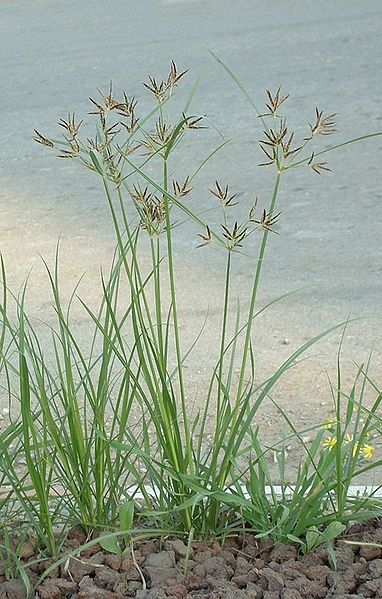
The plant is a member of the sedge family Cyperaceae and is valued for the essential oils found in its nut-like tubers. These tubers give the plant its name of nut sedge or nut grass. The culms are erect, triangular and the leaves are radical, sheathing and shorter than the culms. The roots are tuberous, sweet smelling, rounded, black in colour and are ususally crowded together. It is distributed throughout Himachal Pradesh in moist areas, rice fields and along watercourses up to an elevation of 1500 m. It grows as a gregarious weed in moist places during rains Flowering takes place in July and fruiting in September.
|
| Medicinal uses: |
| Parts used: Tuberous roots |
| Active principles: Terpenes, olealonic acid and its glycosides, beta-sitosterol and essential oils are extracted from the tubers of the plant. |
Disease cured and dosage:
- Ethnomedicinal: The roots are considered as stomachic, tonic, diuretic, demucent, stimulant and galactogogue and are given in fevers, dyspepsia, diarrhea, cholera, urinary calculi and amenorrhoea. As a galactogogue, the fresh tubers are applied to breasts. It is useful in appeasing thirst, stomach disorders, bowels irritation, febrile and dyspeptic affections, in healing wounds, ulcers, abdominal pain and scorpion stings. The extract is anti-inflamatory, antipyretic and analgesic. Its tea is taken during colds and against jaundice. The essential oil is insecticidal, anti-microbial and anthelmintic. A decoction of the tubers of nut-grass, red sandal wood, root of Andropon maricatus, Oldenlandia herbaceae, Pavonia odorata and dry ginger is given as a drink for appearing thirst and relieving heat of the body in fever.
- Ethnoveterinary: Data not sufficient
|
| Ayurveda/Unani prepration: Mustakadi-klwath, mustakadichurna, panchbhadra-kwath, shadang paniya and chandraprabha-vati |
Ayurvedic properties and actions:
- Guna (Qualities): Laghu (light), ruksha (dry)
- Rasa (taste): Katu (pungent), tikta (bitter), kashaya (astringent)
- Vipaka (post digestive taste): Katu (pungent)
- Virya (potency): Sheet (cold)
As per Charaka Samhita, it is considered as triptighna (reduces pseudo-contentment), trishnanigrahan (reduces unusual thirst), lekhniya (reduces corpulency), kandughna (anti pruritic) and stanyashodhan (galactopurifier).
|
Therapeutic description:
- Effect on humours: Alleviates pitta, kapha but it is especially effective for vataj diseases.
- Systemic effects: Treats itching and skin rashes (apply paste), acts as a galactogogue and is used as a collyrium (anjan) in ophthalmic diseases.
- Nervous system: Cures nervine debility and epilepsy.
- Respiratory system: It is used in the treatment of cough and dyspnoea.
- Digestive system: It is used to treat dyspepsia, vomiting, impairment of digestion, IBS (irritable bowels syndrome), pathogenic thirst and worm-infestation.
- Blood vascular system: It is used to cure blood related disorders.
- Urino-genital system: It treats dysmenorrheal and puerperal diseases.
- Skin: Used to treat itching, Scabies and other skin diseases.
- Temperature: Cures chronic fever and post febrile effects.
|
Drug preparation: To convert the plant into a drug, the tubers are cooked in water to prepare soup.
- The medicine is called soup of nagarmotha.
- It must not be stored and ingested immediately.
- It can be used as a liniment or paste externally.
|
|
|
 |
|
| Family:
Cyperaceae |
| Common name:
Nut grass |
| Local name: Nagarmotha, Mustak, Nagkesar (Joshimath), Motha, Nagarmotha (Hindi) |
| Ayurvedic name:
Mustak, Varid |
|
|
|
| File Size:675.0390625kb |
|
|




