| |
|
|
| Species: Ephedra gerardiana Wall. |
|
|
| Plant Profile: |
|
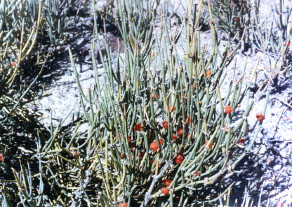
Ephedra is a gymnosperm bearing thin stems, which are woody, cylindrical and approximately 5 mm in diameter. The plant has internodes at a distance of 3-3.5 mm. It is a very slow growing tufted shrub with numerous densely clustered erect jointed branches arising in the form of whorls. The branches have scales at the nodes. The plant bears terminal buds, which are short and usually constricted at the base. The fruits are red in colour, fleshy, succulent and enclosed in a bract with 1-2 brownish-black seeds. Ephedra is distributed in dry rocky zones and open slopes of alpine and temperate Himalayas ranging from 3000-5500 m. The plant flowers from June-September and the fruits ripen in August-September. The plants are mostly collected from the wild sources for traditional use.The alkaloid content of the drug varies from season to season and is the maximum in autumn when the plants are dark in colour.
|
| Medicinal uses: |
| Parts used: Aerial shoots/twigs. |
| Active principles: Alkaloids,ephedrine, pseudoephedrine and indole butyric acid are found in Ephedra gerardiana.The ephedrine content in the Indian variety varies from 0.28-2.79%. Rainfall has adverse effect on the alkaloid content which generally increases with the age of plant. |
Disease cured and dosage:
- Ethnomedicinal: In the Lahaul valley,it is used for curing liver disorders. In Spiti, the powder is used for cough, fever and cardiac ailments. The ash of burnt branches/branchlets is used as snuff. It is also used as blood purifier and in rheumatic pain. Ephedra and its alkaloids show sympathomimetic effects. Hence, it is used as a bronchodilator in asthma and also in the treatment of allergic conditions like hay fever. As compared to adrenaline, the onset of action for ephedrine is slow, but the effect is much prolonged, as it is not quickly hydrolyzed by mono amino oxidase in the body. Ephedrine is used to correct low blood pressure conditions and is also known to have hypotensive effects.
- Ethnoveterinary: Data not sufficient
|
| Ayurveda/Unani prepration: Som-kalp, Som-churna. Prescribed dose - churna:2-3 g, thrice a day. |
Ayurvedic properties and actions:
- Guna (Qualities): Laghu(light),ruksha(dry)
- Rasa (taste): Kashaya(astringent)
- Vipaka (post digestive taste): katu (pungent)
- Virya (potency): Ushna (hot)
|
Therapeutic description:
- Effect on humours: Alleviates vata, kapha.
- Systemic effects: It lessens pain and inflammation conditions.
- Nervous system: It is used in the treatment of mental depression and psychosomatic disorders.
- Respiratory system: It is used to cure bronchitis, dyspnoea, and cough.
- Digestive system: It is used to treat dyspepsia (chewing), abdominal colic, digestive upsets, flatulence, constipation (churna), gulma, piles, jaundice, worms-infestation, irritable bowel syndrome (boiled), liver and spleen disorders and purification of hollow visceral organs.
- Urino-genital system: It is used to treat dysurea and incontinence of urine.
|
Drug preparation: To convert the plant into a drug, the branches or branchlets are dried under shade after harvesting.
- The drug is called Kapa-Zagyor (Tawang) and is grayish yellow in colour.
- The drug must be stored in moisture-free containers.
- It has a shelf life of one year.
- It can be applied externally as paste or powder and ingested or as snuff for internal use.
|
|
|
 |
|
| Family:
Gnetaceae |
| Common name:
Ephedra |
| Local name: Chhe (Lahaul, Spiti and Ladakh), Tse- dhoom (Tibet), Somalata (Hindi) |
| Ayurvedic name:
Soma |
|
|
|
| File Size:817.033203125kb |
|
|
|
| |
| |
|
|




