| Plant Profile: |
|
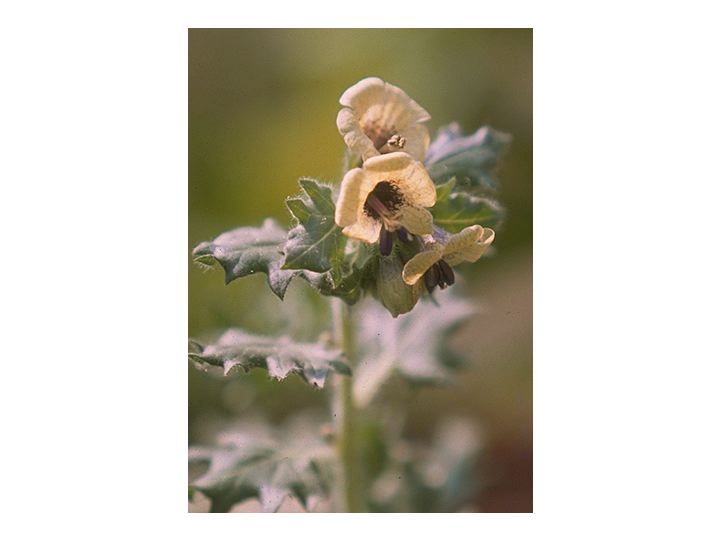
Hyoscyamus nigercan be readily distinguished by its dull yellow cup-shaped flowers, which are conspicuously netted with purple veins and darker, purple centers. It is a coarsely hairy, annual or biennial erect plant growing up to a height of 30-120 cm. The plant emits a disagreeable and strong odour. The stem is robust, hard and dark green and covered with sticky glandular hairs. The leaves are radical, spreading, stalked, oblong-ovate and coarsely sinuate-toothed. The flowers are yellowish green with a dark purple centre and are nearly sessile with the lower ones in the forks of the branches and the upper ones borne solitary in the axils of leaf like bracts in terminal scorpioid cymes. The fruit is a capsule encircled by a globular base of the enlarged calyx. The seeds are knee shaped, brown coloured with reticulated marks. The plant grows wild throughout the Himalayan range at altitudes of 2000-3000 m. Henbane probably originates from Mediterranean region but it is now widely distributed throughout Europe and Asia. Flowering occurs in July and the plants produce fruits in August.
|
| Medicinal uses: |
| Parts used: Seeds and leaves |
| Active principles: The chief constituent of Hyocyamus leaves is the alkaloid hyoscyamine, together with small quantities of atropin and hyoscine. The other constituents of Hyocyamus are glycosidal bitter principle called hyoscytricen, choline, mucilage, albumin, calcium oxalate and potassium nitrate. Hyocyamus seeds have been used as a source of the alkaloid scopolamine. The seeds contain from 0.5-0.6 per cent of the total alkaloids and about 20% of fixed oil. |
Disease cured and dosage:
- Ethnomedicinal: The seeds are used to treat toothaches and skin diseases. The smoke of burnt seeds is blown through wheat straw into tooth cavities to provide instant relief from toothache. Hyoscyamus is largely prescribed as a sedative in mental and maniacal excitement, epileptic, mania, chronic dementia, paralysis, agitations, convulsions, spasmodic cough, whooping cough and asthma.
- Ethnoveterinary: Data not sufficient
|
| Ayurveda/Unani prepration: Parishyadi churna. Prescribed dose: churna 0.25-1 g. |
Ayurvedic properties and actions:
- Guna (Qualities): Ruksha (dry)
- Rasa (taste): Katu (pungent), Tikta (bitter)
- Vipaka (post digestive taste): Katu (pungent)
- Virya (potency): Ushna (hot)
- Prabhava (effects): Madak (sedative), vednasthapana (pain killer)
|
Therapeutic description:
- Effect on humours: Alleviates vata and kapha.
- Systemic effects: It cures mastitis, orchitis, piles and arthritis.
- Nervous system: It is used to treat schizophrenia, meningitis, insomnia, headache and delirium.
- Respiratory system: Cures cough and dyspnoea.
- Digestive system: It is used in the treatment of abdominal colic, flatulence, gulma and worms-infestation.
- Blood vascular system: Used to cure cardiac debility and hemorrhage.
- Urino-genital system: It is used to treat cystitis, renal calculous, lymph-urea, premature ejaculation, spermatorrhoea, dysmenorrhea and leucorrhea.
|
Drug preparation: To convert the plant into a drug, the seeds are dried and ground into powder before using. When the flowering tops along with leaves are used in medicine they are dried under shade and used accordingly.
- The seed powder is black in colour.
- The powder must be stored away from sunlight and has a shelf life of one year.
- It can be externally used as a poultice or smoke. It can be ingested in very minute doses.
|
|
|
 |
|
| Family:
Solanaceae |
| Common name:
Kurasani Ajwain/Parasika yavani, Indian Henbane, Black Henbane |
| Local name: Thang trhom langthang tzey, Jungli datura (Lahaul), Lang dang zay (Spiti), Kurasani Ajwain (Hindi) |
| Ayurvedic name:
Parasika yavani |
|
|
|
| File Size:497.703125kb |
|
|




