Himalayan VOICES High Himalaya FORUM Himalayan Heritage  
 
Search
 
 
View more Databases:
CULTURAL RESOURCES
Tribes
Socio-economic Fabric
Language & Literature
Art, Crafts & Architecture
 
Species:        Inula racemosa Hook f.
Plant Profile:

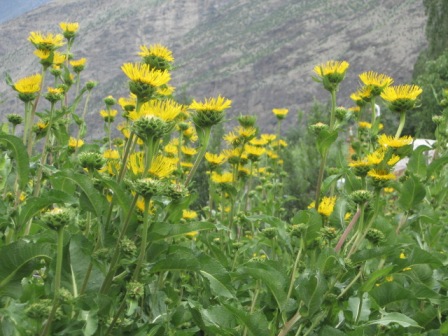
Inula racemosa is a perennial herb with a rough, grooved, erect stem that can grow up to 1.75 m. The stem has large yellow flower heads 4-8 cm across, borne in a spike-like cluster or inflorescence and branched with one or two flower heads at the end of the branches. The innermost involucral bracts are longer than the outer ones and have reddish pappus. The leaves are coriaceous with the lower leaves narrowed to a winged leaf stalk and elliptic-lanceolate while the upper leaves are lanceolate and clasp the stem with large basal lobes. All the leaves have rounded teeth and are densely hairy on the underside. It is found in the temperate and alpine zones of the Western Himalayas ranging between altitudes of 1700-4700 m. It is found in the wild as well as cultivated in Himachal Pradesh (Lahaul and Spiti and Kinnaur districts), Ladhak and Kargil in Jammu and Kashmir. Flowering and fruiting occurs in the month of July and September. It has been observed that the yield of the active ingredients increases with the age of the plant and is maximum in 3-year-old plants.

Medicinal uses:
Parts used: Fresh and dried roots
Active principles: Inulin and an essential oil containing iso-alantolactone and di-hydralactone are present in the roots.
Disease cured and dosage:
  • Ethnomedicinal:  It is an expectorant and resolvent and used for curing rheumatism and gastrointestinal disorder. The roots possess strong anthelmintic properties. The seeds are aphrodisiac.
  • Ethnoveterinary:  It is also used in veterinary medicine as a tonic and stomachic.
Ayurveda/Unani prepration: Pushkarmuladichurna, pushkaradi churna. Prescribed dose: churna 1-3 g.
Ayurvedic properties and actions:
  • Guna (Qualities):  Laghu (light), ruksha (dry)
  • Rasa (taste):  Katu (pungent), Tikta (bitter)
  • Vipaka (post digestive taste):  Katu (pungent)
  • Virya (potency):  Ushna (hot)

      As per Charaka Samhita it is considered shwashar (reduces       dyspnoea) and hikkanigrahan (antihiccough)

Therapeutic description:
  • Effect on humours:  Alleviates vata and kapha but it is especially effective for vataj diseases.
  • Systemic effects:  used to treat pain, inflammation and tubercular wounds.
  • Nervous system:  It is used in the treatment of nervine debility and vataj disorders like hemi paresis.
  • Respiratory system:  Cures chronic cough, hiccough, dyspnoea, pleuritis and pain in the thoracic region.
  • Digestive system:  It is used to cure dyspepsia, abdominal colic, digestive upsets and flatulence.
  • Urino-genital system:  Treats dysurea, incontinence of urine, amenorrhea and dysmenorrhea.
Drug preparation:   To convert the plant into a drug, the roots are dried properly under shade and ground into powder.
  •  The drug is called Nurboo-Dung-Thang (Leh).
  •  It is stored in dry and airtight containers to preserve the volatile parts.
  •  It has a shelf life of 1-2 years.
  •  It is externally used as a paste, poultice or powder.
Family: Asteraceae
Common name: Pushkarmool, Poshkar
Local name: Manu (Lahaul), Manu (Joshimath), Nah-nhoo (Tawang Pohkarmool (Hindi)
Ayurvedic name: Pushkarmool, Padhampatra
File Size:674.69921875kb
Download