| Plant Profile: |
|
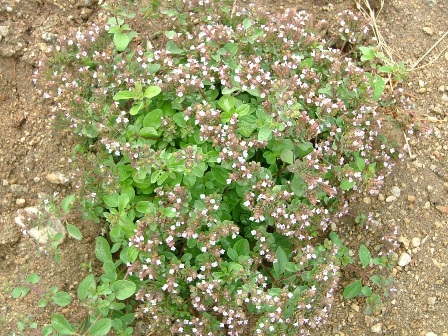
It is an aromatic, branched, perennial herb which grows up to 30-90 cm high. The leaves are broadly ovate and the flowers are in terminal corymbose cymes. The flowers are pale white in colour and the plant possesses aromatic flavour. The herb is found in the temperate Himalayas from Kashmir to Sikkim between an elevation of 1500-3600 m. It is widely found in the districts of Chamba, Kangra, Shimla, Kinnaur, Kullu, Mandi, Lahaul and Spiti, Sirmour and Solan in Himachal Pradesh between 1200-4000 m. It is native to Europe and grows wild on dry sunny slopes, hedge banks, and roadsides and in grasslands, usually on lime-rich soil. The generic name Origanum comes from the Greek word oros (mountain) and ganos (joy). The plant flowers in June and fruits in December. The herb is propagated by seeds, cuttings, layers and root divisions.
|
| Medicinal uses: |
| Parts used: Leaves and top shoot or entire plant. |
| Active principles: The herb contains a volatile oil containing 50% thymol. It has also been reported to yield tannin and a bitter principle. |
Disease cured and dosage:
- Ethnomedicinal: The leaves and tops, cut prior to blooming are used to flavour foods. The plant is also used as a pot herb and as a vegetable in Lahaul. The oil possesses carminative, stomachic, diuretic, diaphoretic and emmenagogue properties. It is also given as a stimulant and tonic in diarrhea and colic and is applied in chronic rheumatism, toothache and earache. It is also used in cough and bronchitis. The oil is used in baths, healing wounds, and stimulates the growth of hair and has extensively used in the cosmetic and soap industry. The paste of the leaves is applied in fire burns, eczematous skin, boils, cuts and wounds.
- Ethnoveterinary: Data not sufficient
|
| Ayurveda/Unani prepration: Swarasa, oil, faant. Prescribed dose: swarasa 5-10 ml, oil 2-5 drops, faant 10-20 ml. |
Ayurvedic properties and actions:
- Guna (Qualities): Laghu (light), ruksha (dry), tikshna (sharp)
- Rasa (taste): Katu (pungent), tikta (bitter)
- Vipaka (post digestive taste): Katu (pungent)
- Virya (potency): Ushna (hot)
|
Therapeutic description:
- Effect on humours: Alleviates vata and kapha.
- Systemic effects: It is used to treat rheumatoid arthritis, headache, toothache, wounds and scorpion bites (paste). It is used in poultice and as a fomentation agent.
- Nervous system: It is useful in treating paralysis and nervine debility.
- Respiratory system: Cures cough, hiccough and dyspnoea.
- Digestive system: It is used to treat dyspepsia, abdominal colic, digestive upsets, flatulence and worms-infestation
- Urino-genital system: Treats dysmenorrhoea and amenorrhea.
- Skin: Cures skin diseases.
- Temperature: It is used to relieve chronic fever.
|
Drug preparation: To convert the plant into a drug, the flower shoots are dried and crushed into a powder.
- The tablets are stored in moist free airtight containers and have a shelf life of 1 year.
- It can be used externally as a poultice lotion, paste, baths and internally by chewing or ingestion.
|
|
|
 |
|
| Family:
Lamiaceae |
| Common name:
Bantulsi |
| Local name: Sathra, Bantulsi, Wild Marjornum, Jakhma Buti, Basloghas (Hindi) |
| Ayurvedic name:
Prachin Marubak |
|
|
|
| File Size:481.9267578125kb |
|
|




