| Plant Profile: |
|
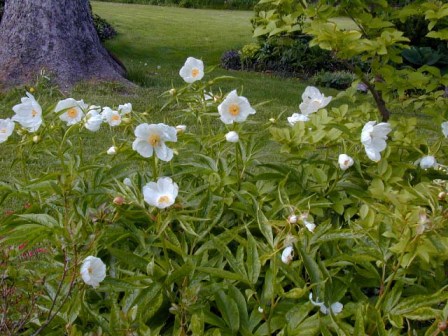
It is a shrubby perennial with large deeply cut leaves and large white flowers with numerous orange-yellow stamens. The flowers are 8-12 cm across with 5-10 elliptic petals and 5 persistent outer sepals. The leaves are 30-60 cm long with lanceolate pointed leaflets or lobes. The fruit is usually a single follicle 3-4 cm, densely hairy or hairless with seeds that turn from scarlet to brown-black. It is found in the north-west Himalayas from Kashmir to Kumaon between 1600-3000 m elevations. Flowering takes place in May and fruiting takes place in June-July. It can be cultivated through rhizome cuttings.
|
| Medicinal uses: |
| Parts used: Tuber/rhizomes |
| Active principles: The roots contain starch (9.5%), sucrose (5.4%), malic acid (0.47%), oxalic acid (0.36%), tartaric acid (0.34%) and benzoic acid. The root oil yields n-alkanes, beta-amyrin, butyropermol, cycloartenol, lupeol and linoleic acid. |
Disease cured and dosage:
- Ethnomedicinal: The fleshy roots are used in uterine diseases, biliousness, dropsy and nervous affections. Excessive doses, however, cause headache, and vomiting. An infusion of the flowers is given for diarrhoea. The tuberous roots are used for intestinal diseases, colic, bilious obstructions, epilepsy, convulsions and hysteria and given to children as a blood purifier. The seeds are emetic. The plant is a central nervous system depressant, hypothadermic, diuretic, anti-inflammatory and useful in gout. Vaids in Joshimath use it as an antispasmodic.
- Ethnoveterinary: Data not sufficient
|
| Ayurveda/Unani prepration: Churna, Prescribed dose: churna 1-3 g. |
Ayurvedic properties and actions:
- Guna (Qualities): Ruksha (dry), laghu (light), tikshna (sharp)
- Rasa (taste): Katu (pungent), tikta (bitter)
- Vipaka (post digestive taste): Katu (pungent)
- Virya (potency): Ushna (hot)
|
Therapeutic description:
- Effect on humours: Alleviates vata and kapha.
- Systemic effects: It is used to cure pain and inflammation (root paste + leaves of neem), black mark over face and freckles.
- Nervous system: It treats vataj diseases particularly convulsions, epilepsy, tetanus, Parkinson’s disease, Bell’s palsy, paralysis, schizophrenia and meningitis
- Respiratory system: It is used in the treatment of bronchitis, dyspnoea, cough and pleuritis.
- Digestive system: Treats abdominal colic, ascites, hepatitis, jaundice and diarrhoea.
- Urino-genital system: Cures pain in urinary bladder, renal colic, calculous, dysmenorrhoea and other uterine disorders.
- Skin: Treats leprosy, erysipelas and other skin diseases.
|
Drug preparation: To convert the plant into a drug, the roots/tubers are washed, dried and crushed into powder.
- The powder must be stored in moisture free containers.
- The powder has a shelf life of one year.
|
|
|
 |
|
| Family:
Ranunculaceae |
| Common name:
Chandra/Himalayan paeonia |
| Local name: Chandra (Joshimath), Udsalap (Hindi) |
| Ayurvedic name:
Ud-salib |
|
|
|
| File Size:851.7998046875kb |
|
|




