| |
|
|
| Species: Pinus roxburghii Sarg. |
|
|
| Plant Profile: |
|
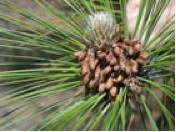
Pinus roxburghii is a moderately tall tree with a spreading crown with whorled branches and reddish brown deeply fissured bark. The leaves are reduced to long needles, borne in clusters of three. The female cones are ovoid and brown and woody when ripe. The seeds have long, membranous wings that aid in their dispersal by wind. The tree is found extensively in the in Siwalik belt of the Himalayas and prefers temperate habitats falling under an elevation of 450-2200 m. Seedlings of the tree are raised through seeds in poly bags and transplanted in pits. Being a hardy species, the survival rate of these seedlings is very high.
|
| Medicinal uses: |
| Parts used: Oleo-resin (turpentine oil) is extracted from the needles of the chir pine. |
| Active principles: Turpentine oil contains a- pinene (20-30%), b pinene (5- 10%), -d carene (55-65 %), longifolene and longicyclene. The needles yield pine oil. |
Disease cured and dosage:
- Ethnomedicinal: It is feebly antiseptic and is useful as an expectorant in chronic bronchitis. It is especially recommended in the treatment of gangrene of the lungs and has been found beneficial as a carminative in flatulent colic, also arrests minor haemorrhages in tooth sockets and the nose. As enema, the oil is useful in obstinate constipation, tympanitis and seat worm infestations. Externally it is used as rubefacient in diseases like lumbago, arthritis and neuralgia. Vaids of Joshimath use turpentine oil to cure skin diseases and the bark for orthopaedic purposes.
- Ethnoveterinary: It is useful in treating certain parasitic diseases like tick and lice infestation in livestock.
|
| Ayurveda/Unani prepration: Surabhidaruk-kwath, surabhidaruk churna, saral kashtha churna, gandhaviroja satva. Prescribed dose - kwath: 30-60 ml., churna: 1-3 g, oil: 1-3 drops. |
Ayurvedic properties and actions:
- Guna (Qualities): Laghu (light), tikshna (sharp), snigdha (slimy)
- Rasa (taste): Katu (pungent), tikta (bitter), madhur (sweet)
- Vipaka (post digestive taste): Katu (pungent)
- Virya (potency): Ushna (hot)
|
Therapeutic description:
- Effect on humours: It alleviates vata, kapha but it is especially effective for vataj diseases (related to the nervous system).
- Systemic effects: It is used to treat arthritis, eleuritis, pain in the thoracic region (turpentine oil + camphor), flatulence (fomentation with hot oil + water), external haemorrhage and wounds (exudates-gandhaviroja).
- Respiratory system: It is used in the treatment of chronic cough, hoarseness of voice and tuberculosis.
- Digestive system: It is used to cure spepsia, flatulence, cholecystitis, worm infestation (especially for tape-worm) and intestinal obstruction.
- Urino-genital system: It is used to treat chronic cystitis, pyourea and leucorrhoea.
- Skin: It is used to treat skin diseases also.
|
Drug preparation: To convert the plant into a drug, an oil or paste is made from fresh buds and bark. This paste can be used directly.
- The drug prepared is called Viroja and is in the form of oil.
- It must be stored in damp free containers.
- The drug can be taken as oil, or in certain cases, the bark can be wrapped over a sprain/dislocated bone.
- It can be externally applied externally as a poultice, lotion or oil. Internally, it can be directly ingested or used as enema.
|
|
|
 |
|
| Family:
Pinaceae |
| Common name:
Chir-pine, Long leaved pine |
| Local name: Chir, Chirh, Saral, Birjora pine |
| Ayurvedic name:
Saral, Surabhidaruk |
|
|
|
| File Size:208.7001953125kb |
|
|
|
| |
| |
|
|




