Himalayan VOICES High Himalaya FORUM Himalayan Heritage  
 
Search
 
 
View more Databases:
CULTURAL RESOURCES
Tribes
Socio-economic Fabric
Language & Literature
Art, Crafts & Architecture
 
Species:        Plantago ovata Linn.
Plant Profile:

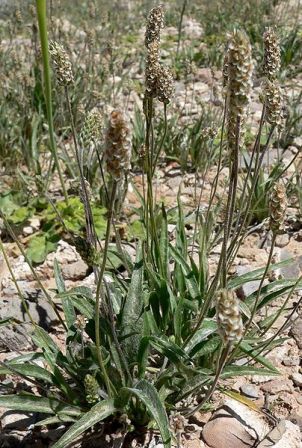
The plant is a perennial herb with an erect stout rootstock and alternate ovate or ovate-oblong obtuse or sub-acute entire or toothed nearly glabrous leaves. The leaves are tapering and decurrent into the petiole and are commonly 7 nerved. The flowers are borne scattered or crowded in long slender rather lax spikes, 5-15 cm long. The capsule is ovoid, 3-4 mm long and glabrous. The seeds are 4-8 angled, rugulose and dull black with usually 8-16 seeds in a capsule. The plant is native to the Mediterranean region and West Asia. In India it grows in Kumaun region of Uttaranchal, Uttar Pradesh and Punjab. The reproductive cycle of this species is form June- October. The aerial part including the leaves, seeds are harvested and seeds are separated out carefully and dried under sun.   

Medicinal uses:
Parts used: Seeds and husk
Active principles: The seeds contain 30% mucilage, which is made up of xylose, arabinose and galacturonic acid. It has 14.7% linolic acid (cholestrol dissolving power).
Disease cured and dosage:
  • Ethnomedicinal:  The leaves are applied as bandage on cuts, bruises and wounds. The pounded seeds are prescribed for gastric disorders. The plant is also useful in rheumatism and griping pain of the bowels. The leaves and roots are astringent and used in fevers. The leaves are applied to bruises and are diuretic, alterative and of cooling nature. The fresh leaves are rubbed on body parts stung by insects, nettle etc. and arrest bleeding of minor wounds. The whole plant is diuretic and used to relieve pains due to piles.
  • Ethnoveterinary:  Data not sufficient
Ayurveda/Unani prepration: Husk of isabgoal. Prscribed dose: 5-10 g.
Ayurvedic properties and actions:
  • Guna (Qualities):  Snigdha, guru, pichhil
  • Rasa (taste):  Madhur (sweet)
  • Vipaka (post digestive taste):  Madhur (sweet)
  • Virya (potency):  Sheet (cold)
Therapeutic description:
  • Effect on humours:  Alleviates vata, pitta
  • Systemic effects:  Used to treat hiro-rog (vata-pattik), anasarca, erysipelas and blisters (paste).
  • Respiratory system:  Cures dry-cough.
  • Digestive system:  It is udes in the treatment of dysentery and diarrhoea.
  • Urino-genital system:  Cures dysurea and pyourea.
Drug preparation:   To convert the plant into a drug, the dried leaves and seeds are ground into a fine powder. A decoction of the leaves is prepared by boiling them in water. Sometimes fresh leaves are crushed to make a paste for applying on cuts and wounds.
  •  The powder must be stored in damp free containers (plastic bottles) and has a shelf life of one year.
  •  It can be taken externally as a poultice or internally by ingestion of the seed powder or a decoction from leaves.
Family: Plantaginaceae
Common name: Spogel seeds
Local name: Karecha, Tharam-naram (Lahaul), Naram (Spiti), Isabgol (Hindi)
Ayurvedic name: Ashwagol
File Size:799.4091796875kb
Download