| Plant Profile: |
|
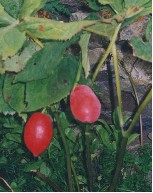
It is a glabrous, succulent perennial herb with an erect unbranched stem bearing two large terminal lobed leaves encircling. The large cup-shaped flowers are borne singly and are white or pale pink in colour. The plants have knotted rhizomes bearing numerous roots. The leaves are long, stalked and palmate with lobed segments. The fruit is oblong, elliptic berry, red on ripening with many seeds embedded in the red pulp. It is found in the temperate Himalayas at an altitude of 2600-4500 m. It occurs in forests, meadows and moist slopes, preferring shaded areas. Flowering occurs in May-June and fruiting in July-August. The ripe fruits are edible and relished by shepherds and local communities. The plant can be cultivated through seeds and rhizome splits.
|
| Medicinal uses: |
| Parts used: Rhizomes and roots |
| Active principles: Podophyllotoxin, picropodophyllin, quercetin and resinous substances are present in the plant. Podophyllotoxin in the rhizome inhibits mitosis (cytotoxic action) and carcinomatous growth. |
Disease cured and dosage:
- Ethnomedicinal: The powdered roots of the plant (3 g) are given in chronic constipation. The pulverized fruits are prescribed for cough and tuberculosis in doses of 2-3 g, taken thrice a day, for 10-15 days. It is also used in gynaecological disorders like menstrual irregularities and uterine diseases. The rhizomes and roots are used as hepatic stimulant, bile expellant, bitter tonic, and for treating warty lesions and skin diseases. It is very effective as a vermifuge, first stimulating, then paralyzing and finally killing Ascaris. It is considered a cancer healer. Traditional healers (amchis) use it in uterus related problems.
- Ethnoveterinary: The plant is used to revive semi dead cells so it acts as a cancer healer.
|
| Ayurveda/Unani prepration: Churna, satva, prescribed dose - churna: 250-500 mg, satva: 15-60 mg. |
Ayurvedic properties and actions:
- Guna (Qualities): Laghu (light), ruksha (dry), tikshna (pungent)
- Rasa (taste): Tikta (bitter), katu (pungent)
- Vipaka (post digestive taste): Katu (pungent)
- Virya (potency): Ushna (hot)
- Prabhava (effect): Raktaarbudnashan (ant cancerous)
|
Therapeutic description:
- Effect on humours: It alleviates vata, kapha.
- Systemic effects: It is used to treat scorpion stings (apply paste locally) and wounds (expressed juice acts as an antiseptic substance).
- Nervous system: It is used to treat insomnia and anxiety neurosis.
- Digestive system: It is used to cure dysentery.
- Blood vascular system: It is also used in the treatment of hypertension.
- Urino-genital system: It is used to cure diabetes insipidus.
|
Drug preparation: To convert the plant into a drug, the roots and rhizomes are cut roughly, dried then ground into a powder.
- It is brown-brownish green coloured powder, which becomes dark on storage.
- The powder should be stored in airtight moisture free container.
- The shelf life of the powder is one year.
- It is administered in the form of crushed roots, powder and paste.
- It can be externally applied as paste made from roots and rhizomes or ingested for internal use.
|
|
|
 |
|
| Family:
Podophyllaceae |
| Common name:
Indian podophyllum, Himalayan Mayapple |
| Local name: Papra/Giriparpat (Lahaul), Bankakri (Joshimath), Bankakri (Hindi) |
| Ayurvedic name:
Bantrapushi, Giriparpat |
|
|
|
| File Size:216.40234375kb |
|
|




