| |
|
|
| Species: Saussurea costus (Falc.) Lipsch. |
|
|
| Plant Profile: |
|
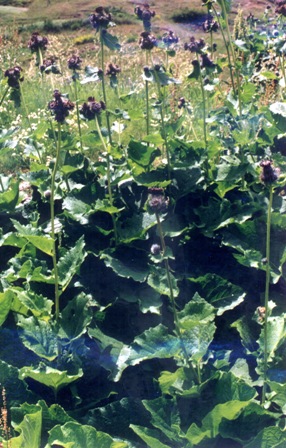
It is a tall robust perennial pubescent herb growing up to 2 m. The basal leaves are large triangular and long-stalked. All leaves are irregularly toothed. The stem has a dense rounded terminal cluster of few purple flower heads with purple involucres. S. costus is cultivated as a field crop in the Western Himalayas. It is also found in the wild in the western Himalaya between an altitude of 2000-4000 m. Flowering and fruiting occurs from July to October. The roots are collected after three years of vegetative growth in the month of September to November for use in traditional medicines. The plant prefers deep rich porous soil.
|
| Medicinal uses: |
| Parts used: Roots |
| Active principles: The root contains about 6% resinoids, 1.5% of essential oil, 0.5% of an alkaloid, fixed oil and traces of tannins and sugar. The constituents of the volatile oil of kuth are costuslactone, dihydrolactone, camphene and several sesquiterpenes. The alkaloid is known as saussurine. |
Disease cured and dosage:
- Ethnomedicinal: Saussurea is useful in the treatment of bronchial asthma especially those of the vago-tonic type and is categorized as an expectorant. The volatile oil of Saussurea has antiseptic and disinfectant properties, especially against Streptococcus and Staphylococcus. It is used as a carminative and stimulant. The drug is also used in chronic skin diseases and in the treatment of rheumatism. An extract obtained by boiling pieces of roots in mustard oil for 30 minutes is used as eardrops for relieving pain. The crushed dried roots can be applied as poultice over painful joints and boils.
- Ethnoveterinary: Data not sufficient
|
| Ayurveda/Unani prepration: Kushthadi churna, kushtadi kwath, kushtadi taila. Prescribed dose: churna 1/4-1 g, kwath 20-40 ml. |
Ayurvedic properties and actions:
- Guna (Qualities): Laghu (light), ruksha (dry), tikshna (sharp)
- Rasa (taste): Tikta (bitter), katu (pungent), madhur (sweet)
- Vipaka (post digestive taste): Katu (pungent)
- Virya (potency): Ushna (hot)
As per Charaka Samhita it is considered as shukrashodhak (spermatopurifiers), lekhniya (reduces corpuleny) and aasthapanog (adjuvents of a type of enema).
|
Therapeutic description:
- Effect on humours: Alleviates vata and kapha.
- Systemic effects: It is used to treat chronic wound, headache, dental pain, arthritis, rheumatism and skin diseases, scar and alopecia.
- Nervous system: It cures epilepsy, convulsions, tetanus and other vataj diseases.
- Respiratory system: It is also used in the treatment of cough, pain in thoracic region, hiccough, dyspnoea, pertusis and asthma (because of bronchodilatory effect).
- Digestive system: Treats dyspepsia, abdominal colic, digestive upsets, flatulence and constipation.
- Urino-genital system: It is used to treat amenorrhea and dysmenorrheal. It also acts as post-partum galacto-purifier, aphrodisiac and spermato-purifier.
|
Drug preparation: The preparation of the drug varies according to the use it is put to. It may be used as a whole drug by extracting it with water or oil or as a powder. In some cases it is crushed and applied locally as poultice.
- The drug is grey to dull brown in colour, aromatic and bitter in taste.
- It must be stored in airtight moisture free containers so that its essential oil part does not get destructed.
- The shelf life of the powder is 1-2 years.
- The drug can be externally applied as a poultice, powder or paste. For internal use, it can be ingested or inhaled.
|
|
|
 |
|
| Family:
Asteraceae |
| Common name:
Kuth |
| Local name: Shafor-eutha, Kuth (Lahaul), Rusta (Ladakh and Spiti), Kuth (Hindi) |
| Ayurvedic name:
Kuth, kushta |
|
|
|
| File Size:490.0087890625kb |
|
|
|
| |
| |
|
|




